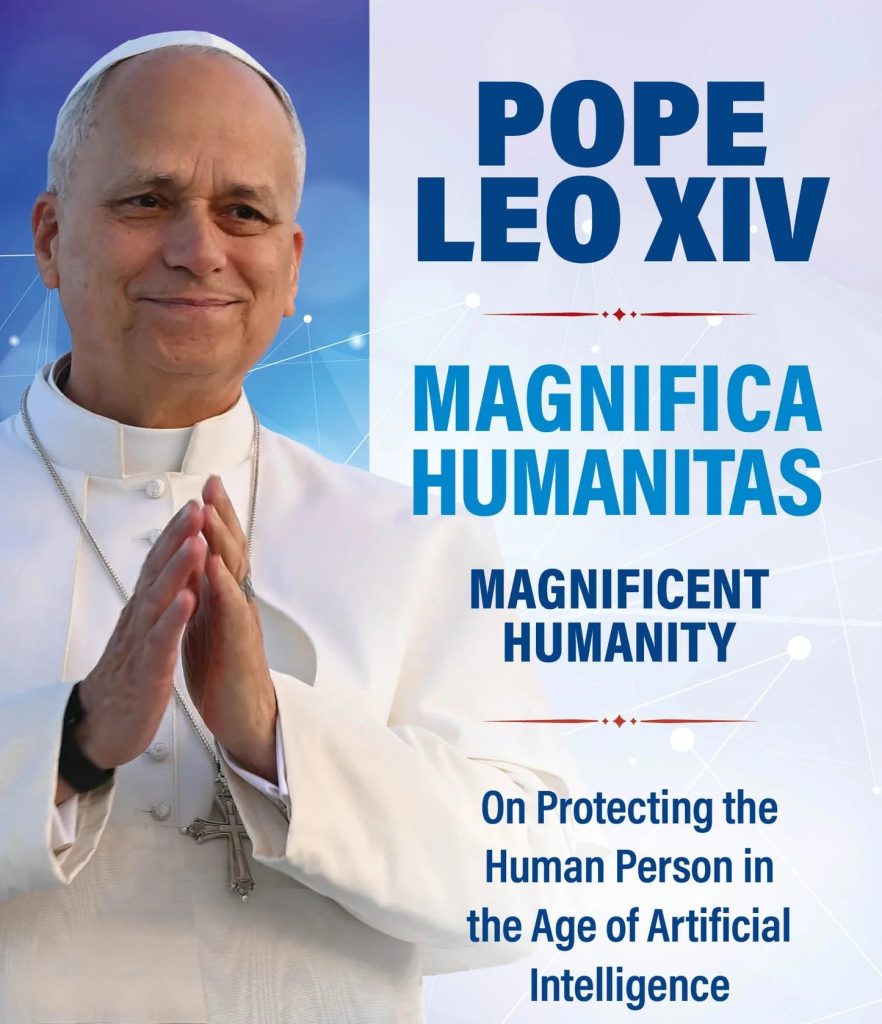
On 15 May 2026, Pope Leo XIV signed his first encyclical, titled Magnifica Humanitas (Magnificent Humanity). It became the latest social encyclical of the Magisterium of the Roman Catholic Church. Notably, Pope Leo XIII’s document On New Things (Rerum novarum, 1891) is traditionally regarded as the first social encyclical, and the new one was published exactly 135 years after Rerum novarum. This points to continuity between the two encyclicals and between the worldviews of the two Leos – the 13th and the 14th.
The language and arguments of the encyclical deliberately extend beyond purely intra-church discourse: the Pope addresses those in positions of authority, legislators, technology developers, and representatives of civil society – in other words, all those who, to a greater or lesser extent, are involved in shaping the digital environment of our time. The introduction to the encyclical sets out two structural axes around which the entire subsequent exposition revolves: the biblical image of the Tower of Babel as a symbol of technological self-deification, and the image of the rebuilding of Jerusalem under Nehemiah’s leadership as a paradigm of shared, God-centered responsibility.
Methodologically, the document consistently engages in a careful reading of historical events and social processes – the so-called ‘signs of the times’ – in light of the Gospel. This approach implies that the Church does not, by its very nature, claim expertise in areas where it lacks it, particularly in the technical sphere. Instead, it offers anthropological and ethical criteria for assessing social processes.
Referring to John R. R. Tolkien’s words, ‘It is not our part to master all the tides of the world, but to do what is in us for the succour of those years wherein we are set, uprooting the evil in the fields that we know, so that those who live after may have clean earth to till’, the encyclical proposes a ‘civilisation of love’: ‘A civilisation of love is born not from a single spectacular gesture, but from small yet constant acts of fidelity that resist dehumanisation.’ The document affirms the ontological dimension of human dignity, pointing out that technology can become not merely a technical problem, but a threat to human nature itself.
The encyclical highlights a paradox that is becoming increasingly apparent in developed economies: automation, promoted as a means of freeing people from routine and dangerous tasks, in practice often subjects people to the rhythm of machines, de-skills them, deprives them of autonomy, and transforms them from subjects of creativity into objects of algorithmic control.
Leo XIV deliberately refrains from two opposing temptations – the technophobic demonisation of AI and uncritical enthusiasm for its capabilities. His central argument is that AI is a tool whose nature is determined not by the technology itself, but by those who develop, fund, regulate, and apply it. Thus, the question is not whether AI should be used, but what vision of humanity and society is embedded in specific systems.
In his encyclical, Pope Leo systematically reproduces the structure of his predecessor’s document, which seeks to interpret the situation through the prism of the unchanging dignity of the human person and the demands of justice. Whilst Leo XIII faced the first industrial revolution, the current pontiff is confronted with what is increasingly referred to as the fourth one – and responds in the same way: by appealing to anthropological principles and by insisting that economic and technological progress be measured by the dignity of every human being, rather than merely by the efficiency of the system.
It is interesting to note that this encyclical recognises the incompatibility of slavery with the Gospel’s understanding of human dignity. Moreover, the Pope sincerely asks for forgiveness for the Catholic Church’s past approval of slavery (§176). Criticism of this practice only became explicit in the nineteenth century – once again, thanks to the initiative of Pope Leo XIII.
Overall, it is important to realise that this encyclical is not a clear-cut institutional blueprint. It proposes the ‘civilisation of love’ as a paradigm, which remains within the document primarily as a spiritual ideal and a pastoral appeal; the encyclical is a document of guidance, not a programme of action. It proposes an alternative ontology: human beings are greater than themselves not because technology enables them to overcome their own limitations, but because they are open to the One who infinitely transcends them – to the eternal God.
As of today, the encyclical has been published on the Vatican’s website in nine languages, including Polish and Russian. The English text of the document can be found here – https://www.vatican.va/content/leo-xiv/en/encyclicals/documents/20260515-magnifica-humanitas.html
On our website, you can read the whole review of Pope Leo XIV’s aforementioned encyclical – https://www.academic-initiative.org.ua/wp-content/uploads/2026/07/Review-of-Leo-XIV-Encyclical.pdf (in Ukrainian)