Contemporary discussions surrounding the legacy of the intellectual leaders of the Catholic Ressourcement movement increasingly focus on the dilemma of authenticity: how to reintegrate ancient Christian texts into the current cultural landscape without reducing them to mere tools for justifying modern ideologies? At the very center of these debates frequently stands the figure of the Swiss thinker Hans Urs von Balthasar, who constructed his universal philosophical and theological project on a multi-level dialogue with the authors of the Patristic era. His attempt to synthesize ancient symbolism with German classical philosophy and literary criticism became a powerful counterweight to the Neo-Scholastic paradigm. At the same time, such a daring synthesis still sparks passionate controversies regarding the legitimacy of freely expanding the boundaries of interpreting authentic Christian sources.
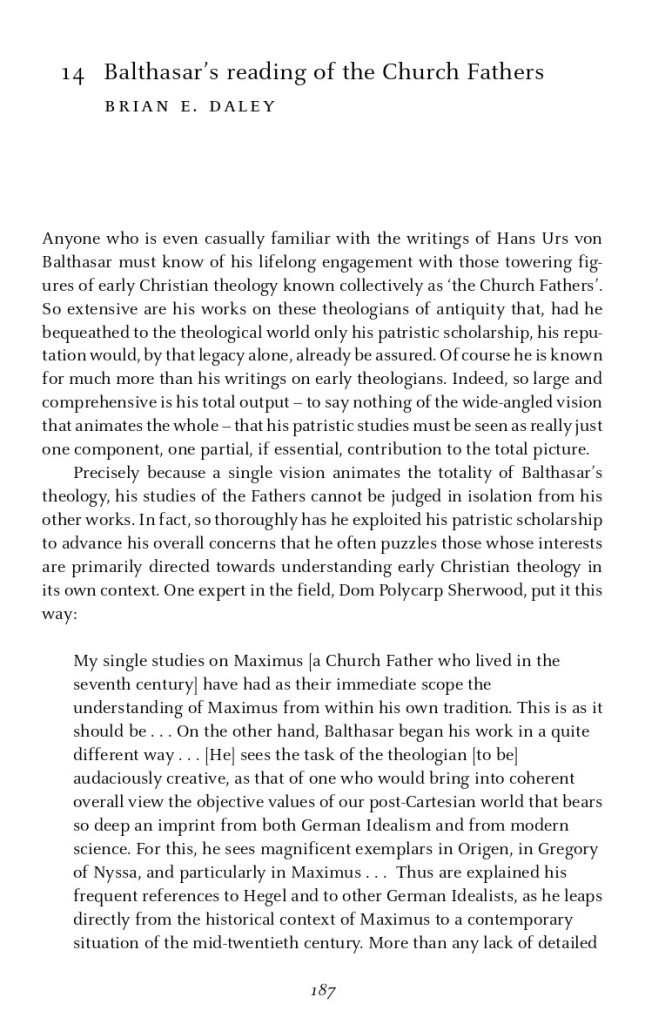
An article by the renowned American patristic scholar Fr. Brian E. Daley, S.J., published in The Cambridge Companion to Hans Urs von Balthasar (2004), particularly addresses this hermeneutical problem. The author of the study assumes the role of an impartial analyst, demonstrating that the portraits of the Church Fathers created by the Swiss thinker are often projections of his own philosophical expectations rather than direct reproductions of the early authors’ thoughts. Despite this methodological shortcoming, Fr. Daley acknowledges Balthasar’s unique status as a catalyst who succeeded in bringing ancient texts to life for the post-Enlightenment world.
In his new academic review of the aforementioned article, Rev. Dr. Andrii Shymanovych suggests viewing Balthasar’s intellectual courage as a necessary condition for developing a living engagement with patristic texts. Fr. Shymanovych draws a parallel with Karl Barth’s neo-orthodox breakthrough, defending every thinker’s right to take methodological risks, without which no progress in theological scholarship is possible. The vitality and continued relevance of Balthasar’s legacy are additionally confirmed by an overview of the latest English-language volumes published in 2026.
You can read Fr. Andrii’s review of Fr. Brian Daley’s study by following this link: https://www.academic-initiative.org.ua/wp-content/uploads/2026/07/19-Daley-Hermeneutic-of-the-Fathers.pdf (in Ukrainian)