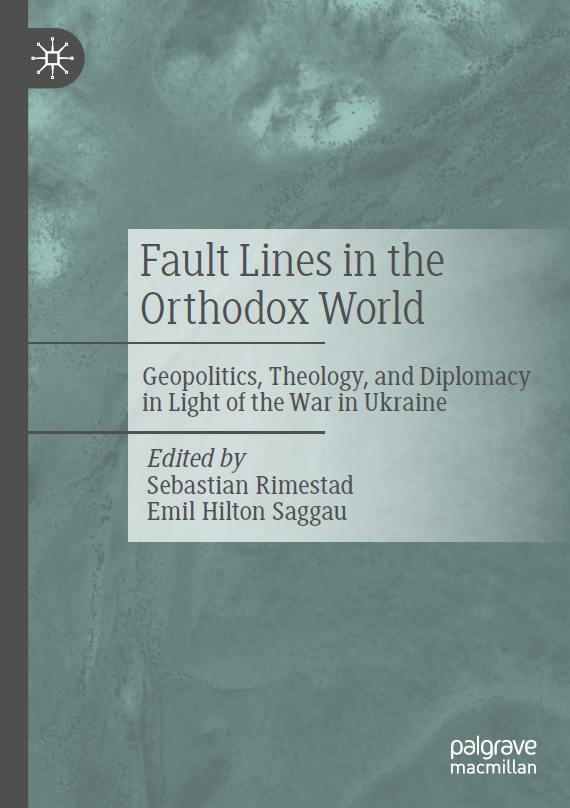
In 2025, the book Fault Lines in the Orthodox World: Geopolitics, Theology, and Diplomacy in Light of the War in Ukraine was published in English. The volume was edited by Sebastian Rimestad and Emil Hilton Saggau, and the contributors included 11 scholars from various European countries and the US. The book was published by Palgrave Macmillan (Springer Nature Switzerland AG). The third part of the book is entitled ‘Russia and Ukraine’, and it contains an article by Volodymyr Bureha on the canonical status of the Ukrainian Orthodox Church (UOC).
The authors emphasise that Orthodoxy is characterised by a territorially fragmented model of institutional organisation. It was precisely this territorial ecclesiology that laid the foundations for the nationalisation of Orthodox identity in the 19th and 20th centuries, and subsequently for the contemporary political instrumentalisation of religion. The editors demonstrate that the current geopolitical divisions are not a random phenomenon, but a logical continuation of a long history of fragmentation and competition.
The book aims to provide a broader overview — from the Balkans and the post-Soviet space to Finland and the Orthodox community in the USA. This approach emphasises that the ‘fault lines’ within global Orthodoxy are both local and global, and that understanding them requires a comprehensive, multidimensional analysis.
The full-scale war in Ukraine has caused and brought to light many problems in the ecclesiastical-legal, moral-ethical, and socio-demographic spheres. These include tensions between jurisdictions and disputes over autocephaly; dilemmas regarding participation in the war or its condemnation within ecclesiastical discourse, and the corresponding consequences for the clergy and laity; changes in the composition of Orthodox communities brought about by mobility and migration; and the new role of churches as factors in foreign policy and security at regional and global levels.
An article by Professor Volodymyr Bureha deserves special attention from Ukrainian readers. His article is entitled “The Ukrainian Orthodox Church Facing the Challenge of War: The Relations with the Moscow Patriarchate and the Problem of a New Canonical Status”.
In the concluding section of his article, Volodymyr Bureha systematically sets out the arguments of both the supporters of the Ukrainian Orthodox Church and its critics. Each of these positions appears quite convincing and self-contained. In this context, he formulates his own position as follows:
“The problem is that the UOC has found itself in a sort of ‘grey zone’. It is simply impossible to unambiguously define its status today”. As an analogy, he cites the example of the Greek Church during the war for Greece’s political independence from the Ottoman Empire. Just as the Church of Greece declared its autocephaly in 1833, after the war had ended, so “It is entirely obvious that the status of the UOC can only be ultimately defined after the end of the war”.
Volodymyr Bureha concludes his article as follows: “It is also absolutely clear to me that the decision on the status of the UOC can only be achieved as the result of a consensus among all the Orthodox churches, but the prospects for that seem rather bleak at the moment”.
You can read the entire review of the aforementioned book via this link: https://www.academic-initiative.org.ua/wp-content/uploads/2026/07/06-Fault-Lines-review.pdf (in Ukrainian)