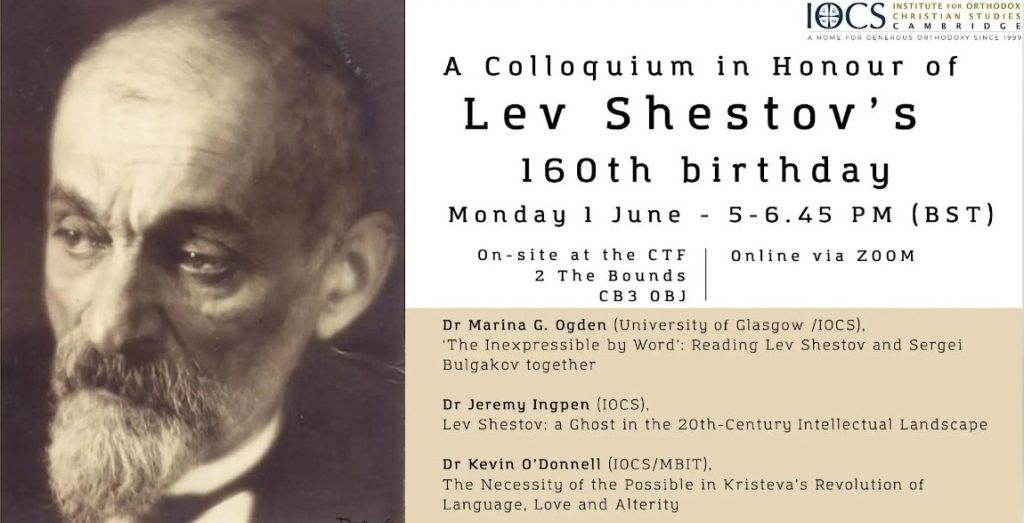
On June 1, 2026, the Institute for Orthodox Christian Studies (Cambridge, UK) hosted an academic colloquium commemorating the 160th anniversary of the birth of Lev Isaakovich Shestov (1866–1938), a prominent twentieth-century philosopher.
In the first presentation, “Lev Shestov: a Ghost in the 20th-Century Intellectual Landscape,” Dr Jeremy Ingpen (IOCS), an expert in the theology of Olivier Clément, reflected on the views of M. Berdyaev, V. Zenkowski, A. Camus, O. Clément and other thinkers regarding the unjustifiably modest presence of Shestov’s ideas in the major theological and philosophical debates of the 20th century. Jeremy Ingpen revealed the essence of Shestov’s epistemological principle, according to which true thinking arises at the moment of a person’s utmost vulnerability, when the boundaries are blurred between the divine and the human, the Self and the other person.
According to Ingpen, Shestov actively contributed to the deconstruction of post-Enlightenment Cartesian reasoning and became one of the founders of supra-rational theologising in terms of reason, crucified by the unfathomable mystery of God’s incarnation. The paper also discussed Shestov’s critique of Martin Heidegger’s early philosophy, at the very core of which Ingpen sees a conflict between Shestov’s Jewish origins and Heidegger’s sympathies towards German National Socialism of the 1930s. Finally, Dr Ingpen noted a regrettable problem, namely the lack of introductory books in English that would familiarise readers with Shestov’s philosophical legacy.
Dr Marina G. Ogden (University of Glasgow/IOCS) – an expert on Shestov’s philosophy and the author of two books and a number of academic articles – presented the audience with a comparative analysis of Shestov’s religious philosophy and the theological programme of Archpriest Sergii Bulgakov – two strands of the religious-philosophical renaissance of the ‘Silver Age’. Marina Ogden examined the life trajectories and intellectual evolution of both thinkers, who met and maintained a years-long correspondence despite distinct worldview differences, sharing their thoughts on the apocalyptic nature of the 1917 Revolution and the role of the intelligentsia against the backdrop of radical social upheaval.
The speaker also explored the extent to which the famous book The Varieties of Religious Experience (1902) by the American psychologist and philosopher William James influenced the religious philosophy of both thinkers and their understanding of the personal and experiential dimension of the Christian faith.
Revd Dr Kevin O’Donnell (IOCS) – formerly Anglican, and now a Catholic priest – drew parallels, identifying similarities and differences between the importance of language in Shestov’s philosophy and the poststructuralist philological studies of the French thinker of Bulgarian origin, Julia Kristeva.
Each of the speakers provided insightful answers to participants’ questions, making a significant contribution to re-evaluating the substantial yet underestimated influence of Lev Shestov’s religious philosophy on the European intellectual tradition.
It is worth recalling that Lev Isaakovich Shestov was born in Kyiv and graduated from Kyiv University of St. Volodymyr. He was a prominent existentialist philosopher who made a significant contribution to the understanding of the limitations and inadequacies of system-based scholarly thinking for the adequate interpretation of the world and the role of the individual within it. Shestov’s philosophy is characterised by a distinct existential orientation, which prioritises the particular individual and the reflection on his or her tragic existence in the world, whilst also challenging established normative ethical systems. Shestov’s scholarly interests ranged from Parmenides and Plotinus to Edmund Husserl, Max Scheler and Georges Bataille.