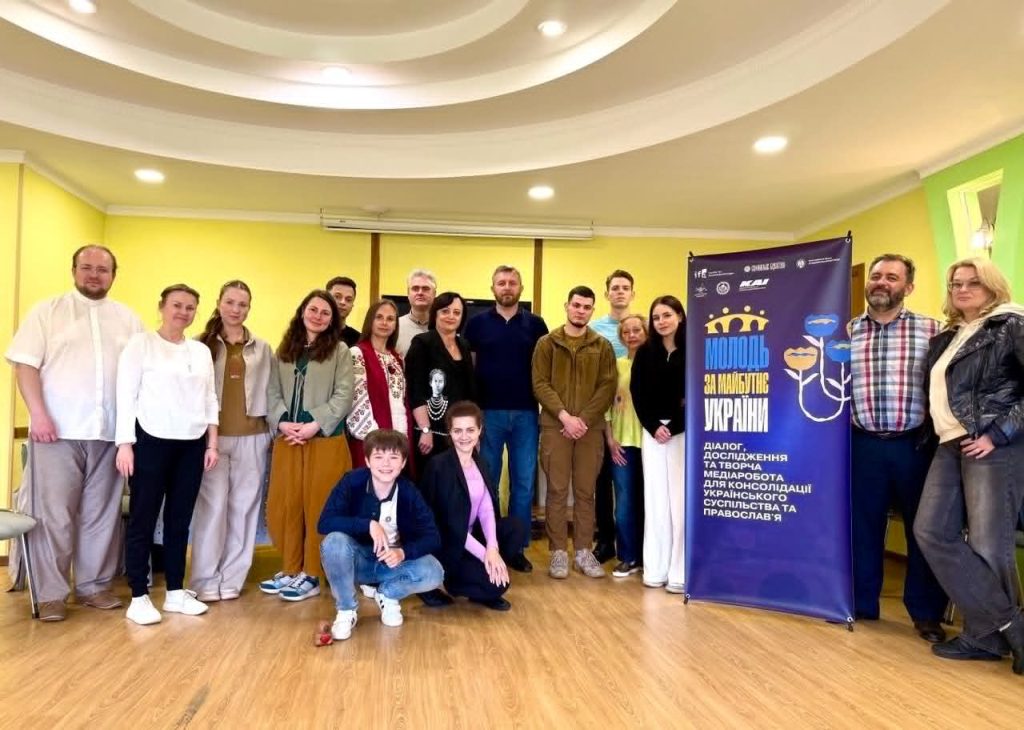
On 2–3 June 2026, a scientific and practical conference entitled “The Common Good: Values and Principles for the Reconstruction of Ukraine” was held in Kyiv. The event was organised by the non-governmental organisation “Sofia Brotherhood”, with the “Academic Initiative” Charitable Foundation serving as one of the key sponsors.
The first day of the conference took on a more academic tone, with a number of academics delivering presentations. In particular, Professor Serhii Proleev examined the ancient concept of the common good as expounded by Aristotle and the medieval interpretation of it in the teachings of Aquinas. Professor Proleev also shared his thoughts on the nature of true peace, which lies not only in overcoming external aggression, but also in building a social environment free from internal manifestations of violence.
Professor Mykhailo Boichenko devoted his presentation to the issue of the universally binding and normative nature of the common good and the ethical dimension of social coexistence. In his view, the deeper meaning of the current Russian-Ukrainian war is preserved only if Ukraine remains true to its democratic identity and its choice of a European civilization. At the same time, Professor Boichenko’s ‘common good’ project envisages the exclusion of entire sections of Ukrainian society, in particular the so-called “draft dodgers”. It is precisely this, in his view, that should form the foundations of a “new democracy” and serve as a “model for other countries around the world”.
Drawing on sociological data, Dr Kateryna Nastoiashcha highlighted the problem of modern Ukrainian society’s rejection of refugees and internally displaced persons, and the development of a sense of guilt amongst them. Mrs Nastoiashcha also equated and identified the Ukrainian Orthodox Church with the Russian Orthodox Church in all aspects of its activities, despite countless statements by representatives of the UOC regarding the severing of all administrative ties with the Russian Orthodox Church. This calls into question her understanding of the concept of the common good, which by definition should be inclusive and unifying.
Religious thinker Tetiana Derkach addressed the pressing issues of state corruption, the unprincipled conduct of military commissars, and the impact of these phenomena on the institutional design of the state. The speaker also highlighted the problem of the balance between the state’s coercion of citizens to fulfill their duties and the erosion of the legitimacy of state authority itself. According to Mrs Derkach, the escalation of existing problems carries the risk of leading to social entropy and turning into a “perfect storm” within the state and society.
On the second day, the conference continued in a more dialogue-based format. In particular, there was an in-depth and frank panel discussion involving representatives of youth and civil society organisations from Ukraine. The meeting brought together both young activists and experienced experts, religious leaders and dialogue facilitators, and served as a platform for analysing the challenges of the current war.