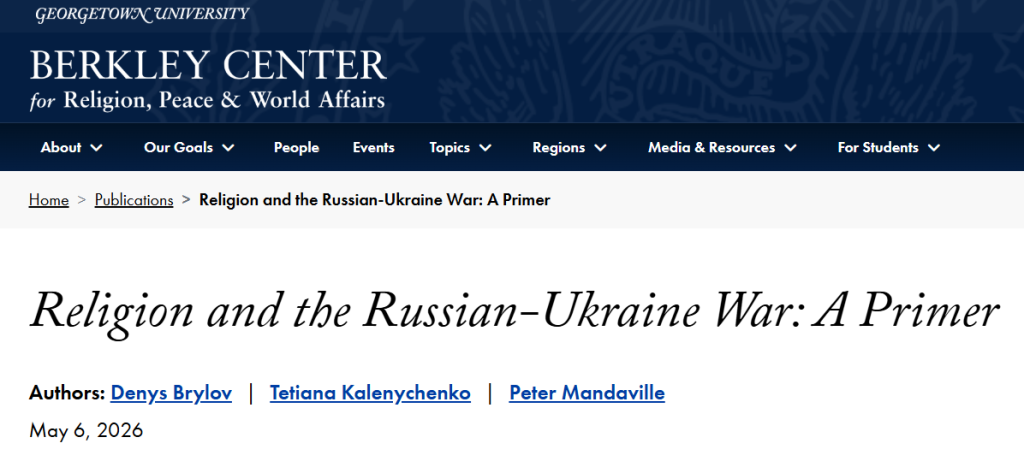
In May 2026, the Berkley Center for Religion, Peace, and World Affairs published a working paper titled “Religion and the Russia-Ukraine War: A Primer.” The study is a part of a larger Georgetown University project titled “The Geopolitics of Religious Soft Power.” The authors of this paper are researchers from Ukraine – Denys Brylov and Tetiana Kalenychenko, co-founders of the “Dialogue in Action” community (https://www.dialogueinaction.com.ua/), as well as Peter Mandaville, a senior research fellow at the Berkley Center.
The researchers rightly note that since the start of Russia’s full-scale invasion of Ukraine, one of the indicators of escalating tensions in Ukraine’s religious sphere has been the rapid intensification of the conflict between the OCU and the UOC: “Public stigmatization of the UOC—by representatives of the OCU, political actors, and segments of wider society—has contributed to declining trust in religious institutions and, in some cases, to broader concerns about social cohesion” (p. 2).
However, the authors add that the further social marginalisation of the UOC and the possible withdrawal of its parishes from the official state register could enable the Russian Federation’s propaganda apparatus to exploit these cases to undermine the internal cohesion of Ukrainian society and to portray the Ukrainian government’s actions regarding the UOC as a violation of religious freedom.
The document highlights the important role played by Ukrainian churches during the Orange Revolution (2004) and the Euromaidan protests (2013–2014), “in practice, however, religious affairs are highly politicized, particularly with respect to Orthodoxy” (p. 3).
The working paper also covers the following aspects:
– Russian media and the Russian Orthodox Church present the war in a sacralised context, specifically as a so-called ‘holy struggle’.
– Russians’ religious identity is intertwined with state-centred and ethno-national ideological narratives.
– The administrative separation of the Ukrainian Orthodox Church (UOC) from the Russian Orthodox Church (ROC) in 2022, whilst maintaining their canonical ties to this day, remains a contentious and frequently debated issue.
– Internal ideological heterogeneity prevails among the hierarchs, clergy, and parishioners of the UOC.
– Regarding the Law No. 3894-IX ‘On the Protection of the Constitutional Order in the Sphere of Religious Organisations’, adopted in August 2024 by the Verkhovna Rada of Ukraine, it is stated that “the law has intensified debate within Ukraine over the balance between security imperatives and religious freedom, while also attracting close scrutiny from international observers concerned about precedent, proportionality, and due process” (p. 5).
This study is intended for government officials, religious analysts, media experts, religious scholars, theologians, and anyone interested in a more in-depth understanding of the religious dimension of the Russian-Ukrainian war.
The full English version of the working paper can be found on the website of our ‘Academic Initiative’ Foundation (https://www.academic-initiative.org.ua/wp-content/uploads/2026/05/Berkley.pdf).