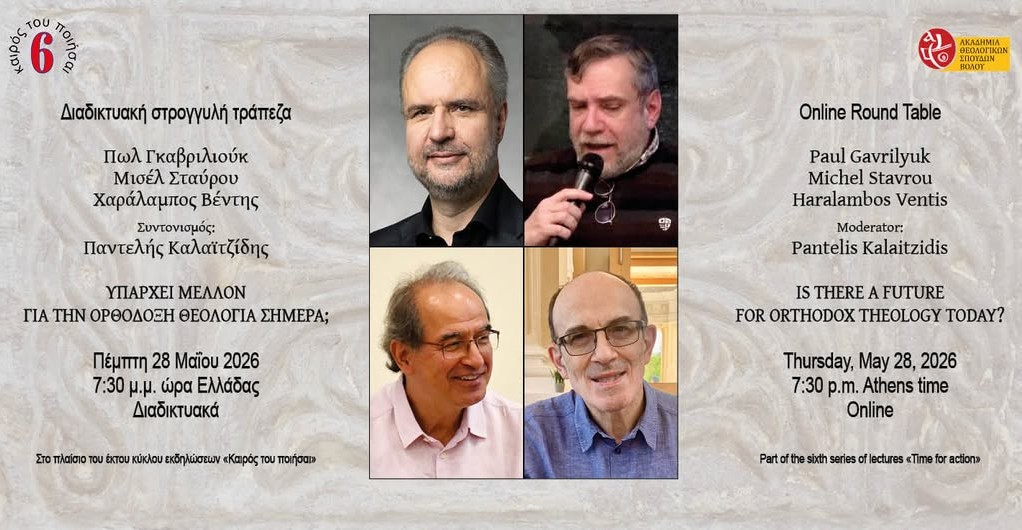
On 28 May 2026, a round-table discussion was held on the topic ‘Is There a Future for Orthodox Theology Today?’. It was the fourth and final round-table in a series of online meetings under the umbrella title ‘Time for Action’, organised by the Volos Academy for Theological Studies.
The discussion was attended by participants from Greece, the USA, and France: Professor Paul Gavrilyuk, University of St. Thomas (St. Paul, MN, USA), President of the International Orthodox Theological Association (IOTA); Professor Michel Stavrou, Dean of the St. Sergius Orthodox Theological Institute in Paris; and Professor Haralambos Ventis, University of Athens. Traditionally, Dr. Pantelis Kalaitzidis, Director of the Volos Academy, moderated the discussion.
The first speaker, Prof. Paul Gavrilyuk, highlighted the relevance of theological education for young people within the Church and the importance of involving them in social and educational ministry worldwide. The institutional organisation of Christian youth activities, whether through small or global organisations such as the IOTA headed by Prof. Gavrilyuk, can significantly contribute to this effort. Attention was once again drawn to the distortion of Orthodox doctrine by the leadership of the Russian Orthodox Church, which employs the rhetoric of the era of the Crusades, as well as to the ROC’s uncritical subservience to the Russian Federation’s authorities.
In conclusion, Prof. Gavrilyuk expressed his solidarity with the prophetic view of Metropolitan Kallistos (Ware) that the 21st century will, for the Orthodox Church, be above all an era of seeking new answers to questions arising in the sphere of Christian anthropology: the controversy surrounding interaction with AI, gender issues, and ways to overcome the ecological crisis. Gavrilyuk’s main thesis is as follows: the future of Orthodox theology depends on people, on investing in the education of youth, and on granting them the necessary academic freedom.
Prof. Michel Stavrou emphasised the importance of responding to the intellectual challenges of the postmodern era and of supporting ecumenical projects, which are not a ‘blurring of dogmas’ but a fraternal Christian endeavour to listen to one another. Prof. Stavrou also shared his view on the problem of Local Churches sliding into national provincialism, when they confine themselves within the borders of their own states and take on some of the functions of foreign ministries or even defence ministries. The speaker therefore called for the further strengthening of Orthodox universalism as a promising alternative to the imperial and national models of the Church, both of which should now be recognised as archaic. Furthermore, the question of the primacy of the Ecumenical Patriarch, in Stavrou’s view, must be approached only in terms of charitable service, rather than vertical imperial authority.
In his report, Prof. Haralambos Ventis called on the Church to move beyond its attachment to the past and open itself up to honest dialogue with modern science, placing Orthodox anthropology in contrast to atheistic naturalism. Referring to the modesty of true scholarship, which always leaves room for doubt and seeks answers that could undermine the existing theories, Ventis noted that theology must give up its self-sufficiency and its desire to shield itself from demands for accountability. He also criticised the use of religion for political purposes and insisted on the need to find new meanings in a secular world.
It should be noted that four online discussions were held this year as part of the ‘Time for Action’ initiative:
1. Religiosity and the False Self (January 21).
2. Artificial Intelligence and Challenges for Orthodox Anthropology (February 16).
3. Holiness Today (April 27).
4. Is There a Future for Orthodox Theology Today? (May 28).
The series of meetings clearly showed that modern Orthodox theology seeks to engage in lively and open dialogue with the challenges of the 21st century. Overall, the events covered the most important areas of intellectual development – ranging from interdisciplinary dialogue with psychology and digital technologies to the reinterpretation of traditional concepts of holiness. The main outcome of these intellectual discussions was a focus on the human person, who today finds oneself at the intersection of technological progress and profound psychological crises. Participants in the discussions emphasised that the future of Orthodox thought depends, above all, on its ability to comprehend scientific achievements, engage with information technologies, and respond with sensitivity to the pastoral challenges of our time.
These events have once again confirmed the Volos Academy’s status as one of the leading forums for exploring the most complex theological issues of our time. The conclusions outlined during the online discussions not only enriched academic discourse but also set out practical guidelines for preserving human identity and Christian morality in an era of new global transformations. The formulated approaches and criteria have the potential to serve as a solid foundation for the Church’s future pastoral, social, and ecumenical initiatives.
You can watch the video on the future of Orthodox theology here: https://www.youtube.com/watch?v=AJumZk3ibv4
Video recordings of all the online discussions from the ‘Time for Action’ series can be found on the Volos Academy’s YouTube channel: https://www.youtube.com/@VolosAcademy/videos