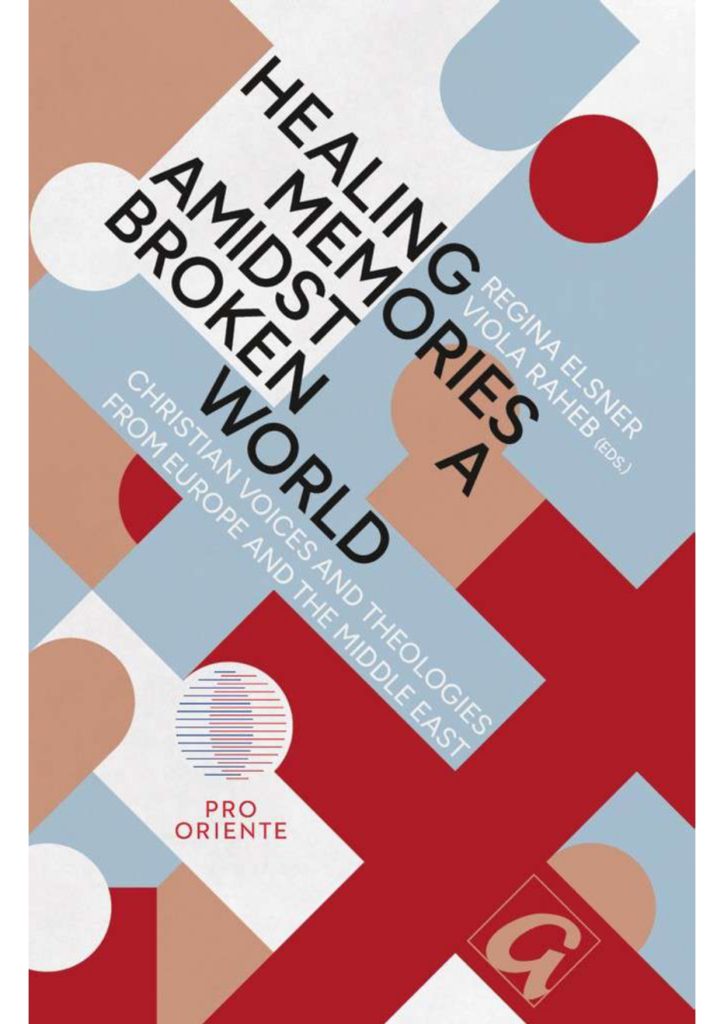
In May 2026, the book “Healing Memory amidst a Broken World” was published. It is based on materials from five conferences held between November 2023 and November 2025: two in Vienna and three in other European cities. These conferences took place as part of the joint project “Healing Wounded Memories”. Sergii Bortnyk was one of the authors of this volume.
The book’s subtitle is “Christian Voices and Theologies from Europe and the Middle East”. In total, the collection features 28 authors from the respective countries and the USA. The book consists of three parts – “Common Theological Heritage and the Contextual Historical Past”, “Voices and Themes from the Context” and “Perspectives on the Future of Ecumenical Relations in Light of Ongoing Wars and Contestations”.
Sergii Bortnyk’s article “Theological Discourse and Local Practice: Ukraine” opens the second part of the book. It is based on the presentation given in November 2023 and emphasises that, in the sphere of church relations in Ukraine today, the focus is more on “creating new wounds” than on healing them. At the same time, an important process of gradual re-evaluation of the identity of believers is taking place in Ukraine, particularly among the faithful of the Ukrainian Orthodox Church.
The author emphasises that the most pressing issue facing Ukrainian Orthodoxy is that of church-state relations. On the one hand, the Ukrainian state and the wide public are demanding that the Ukrainian Orthodox Church makes changes to its relationship of canonical dependence on the Russian Orthodox Church. On the other hand, the leadership of the Ukrainian Orthodox Church is keen to preserve the unity of its structure despite the diversity of political views among its faithful. The state’s demand for “separation from Moscow” is perceived by many believers as a step towards a schism.
Today, the Ukrainian Orthodox Church faces a choice as to which form of unity it will opt for: whether to maintain canonical unity with the Russian Orthodox Church, or to restore unity with World Orthodoxy. The problem, however, is that many view the restoration of relations with the Patriarchate of Constantinople solely as a merger with the structure of the Orthodox Church of Ukraine, something for which the leadership and a significant number of the UOC’s faithful are not ready.
In conclusion, Sergii Bortnyk emphasises that, given the ongoing war, achieving structural unity within the Orthodoxy in Ukraine is not a priority in the immediate future. More important is the severing of administrative ties with the Russian Orthodox Church, which has already taken place following the council in Theofania in May 2022, and the gradual strengthening of a Kyiv-centred identity among the faithful of the Ukrainian Orthodox Church. It is better to have peaceful coexistence between the two Orthodox jurisdictions in Ukraine than to risk leaving wounds in the perception of the faithful as a result of forced unification – wounds that would outlast the current war by many years. We have a scan of Sergii Bortnyk’s article in English on our website – https://www.academic-initiative.org.ua/wp-content/uploads/2026/05/31-healing_of_wounded_memories.pdf