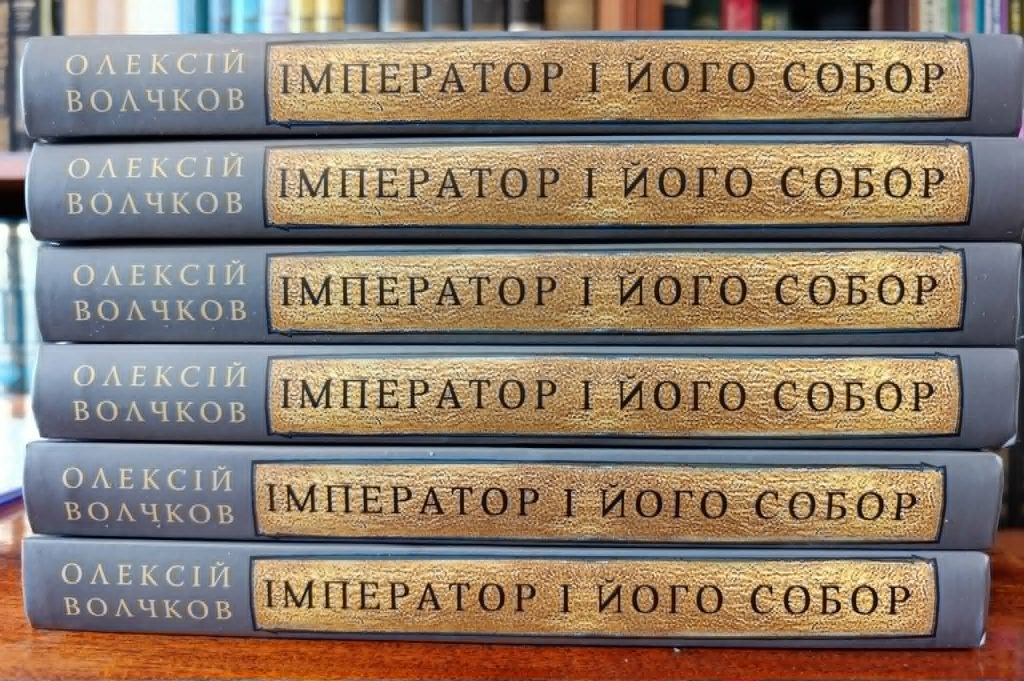
In early August 2026, with the support of the German ‘Renovabis’ Foundation and the Ukrainian ‘Academic Initiative’ Foundation, Oleksii Volchkov’s study The Emperor and His Council went to press. This volume was issued to mark a significant historical milestone – the 1,700th anniversary of the Council of Nicaea.
This work invites the reader to travel back to the early fourth century, when the Church had gained its long-awaited freedom and was taking its first steps towards formulating the doctrine of the Holy Trinity, drawing on the philosophical apparatus of antiquity. It was at this time that an urgent need arose to reconcile, in dogmatic terms, strict biblical monotheism with the recognition of the Son of God’s divine status.
Maintaining a high standard of academic neutrality, the author offers a fresh perspective on the circumstances surrounding the Council of 325 AD. He boldly moves away from outdated stereotypes about the theological debates of the time between the ‘orthodox’ and the ‘heretics.’ Instead, Volchkov reconstructs the vibrant, multifaceted life of the Church – filled with sophisticated intellectual debates – at that pivotal historical juncture.
The key advantage of Oleksii Volchkov’s study is that the author encourages us to examine the Council of Nicaea as a dynamic event and a large-scale, dramatic religion-political panorama of the era, in which the most important role was played not by historic monuments set in bronze, but by living, controversial human beings. They were all driven by their own motivations and systems of belief, passionately defending what they considered to be the truth: these include Emperor Constantine, the presbyter Arius, the bishops Alexander and Athanasius of Alexandria, Hosius of Córdoba, Marcellus of Ancyra, both Eusebius (of Caesarea and of Nicomedia), as well as countless other important personalities.
The author depicts the proceedings of the Council, allowing its key figures to articulate their theological perspectives based on authentic historical texts. Volchkov unfolds the main ceremonial events before the reader’s mind’s eye in the greatest possible detail, whilst also analysing such non-trivial questions as:
– Did the participants of the Council pray together and celebrate the Divine Liturgy together?
– Why did the adoption of the Nicene Creed fail to resolve the ecclesiastical crisis?
– Did the emperor intend this Council to serve as a means of reconciliation with the Melitians, Novatians, and other schismatic communities?
The publication of this comprehensive volume is a significant event for the Ukrainian theological community, as there has been a critical lack of original, comprehensive historical and canonical studies on this subject, published in Ukrainian and based on an analysis of primary sources and the key thematic research of Western scholars. Despite its rigorous academic approach, the book is written in a remarkably light, lively and accessible style aimed at a wide audience. Readers who are not experts in the field can freely enjoy the dynamic historical narrative, whilst academic researchers will find all the necessary information at the bottom of the pages to delve deeper into the material presented by the author.
The book can be ordered by contacting +38097 3964596. Anyone interested can also view the contents of Volchkov’s research in detail and order it by following this link: https://title-book.church.ua/imperator-i-yoho-sobor-do-1700-richchia-nikeiskoho-soboru-volchkov-o.s./