The question of humanity’s place in the universe, its unique dignity, and the limits of its freedom remains one of the most pressing intellectual challenges of our time. Over the past few centuries, modern European culture has attempted to construct autonomous, purely horizontal forms of humanism that rejected the “God hypothesis” in the name of human emancipation and the exaltation of human ontological status. However, as the history of the twentieth century has shown, replacing the transcendent dimension of being with materialism and radical scientific positivism did not result in the triumph of freedom but in the paradoxical devaluation of the person, the fragmentation of one’s essence, and existential emptiness. This spiritual and anthropological crisis compels contemporary theological thought to conduct a thorough analysis of the origins of secularization and to seek reliable philosophical tools for intellectual resistance against the destructive ideological traps of today.
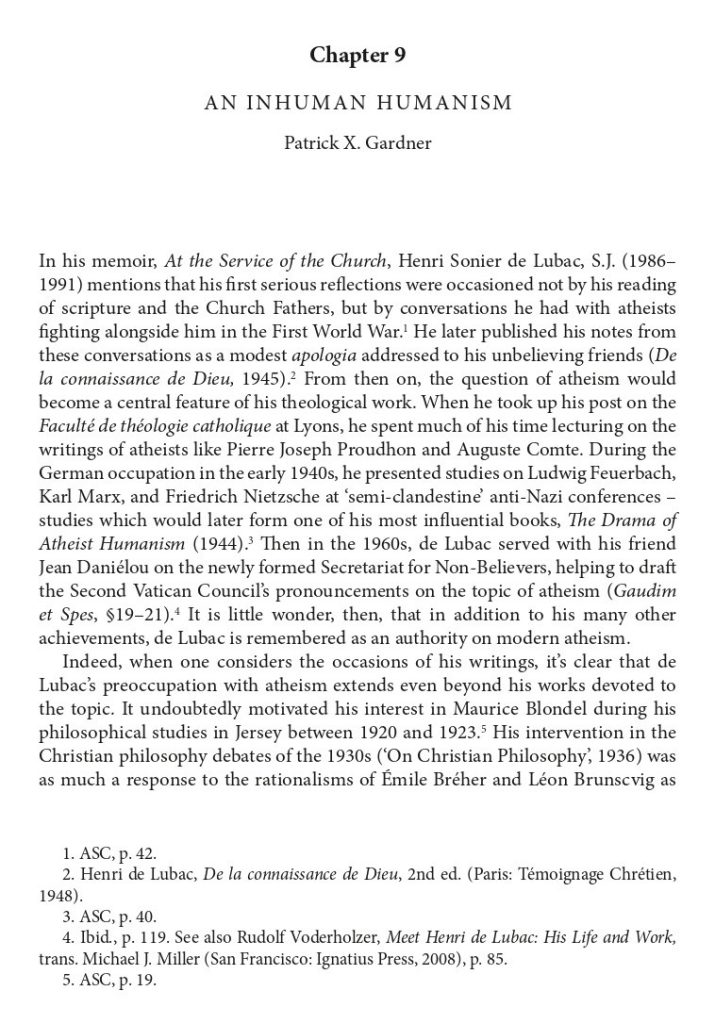
A brilliant example of such meticulous reflection is the article by American scholar Patrick X. Gardner, “An Inhuman Humanism,” which appears in the authoritative volume T&T Clark Companion to Henri de Lubac (2017). In his essay, the author offers an in-depth analysis of the work of the eminent French Jesuit theologian Henri de Lubac (1896–1991), who has gradually deconstructed the ideas of the four main architects of modern atheism – Ludwig Feuerbach, Karl Marx, Auguste Comte, and Friedrich Nietzsche. The main thematic lines of the study expose the fatal illusory nature of materialist optimism, the Marxist instrumentalization of the human being as a purely economic function, positivist sociolatry, and the Nietzschean drama of the “eternal return.” In contrast to these concepts, Gardner highlights de Lubac’s Christological, ecclesiological, and Trinitarian synthesis, in which, through conciliar ecclesial communion, all the philosophical antinomies and paradoxes of the modern era are eliminated, restoring to the human person our original, irreducible multidimensionality.
To familiarise the Ukrainian intellectual community with this crucial aspect of the master from Lyon’s legacy, Rev. Dr. Andrii Shymanovych has prepared a detailed academic review of Patrick Gardner’s article. In his study, Fr. Andrii not only expertly examines and reconstructs the ideological constructs of nineteenth-century atheist thinkers but also draws profound parallels in terms of values with the contemporary Ukrainian context. The review’s author emphasises that profound theological analysis and philosophical reflection constitute a form of humanistic resistance and the defence of human dignity against the backdrop of the ongoing Russian-Ukrainian war.
You can read Fr. Shymanovych’s review of Patrick Gardner’s article “An Inhuman Humanism” via this link: https://www.academic-initiative.org.ua/wp-content/uploads/2026/06/18-Gardner-anatomy-of-anthropological-collapse.pdf